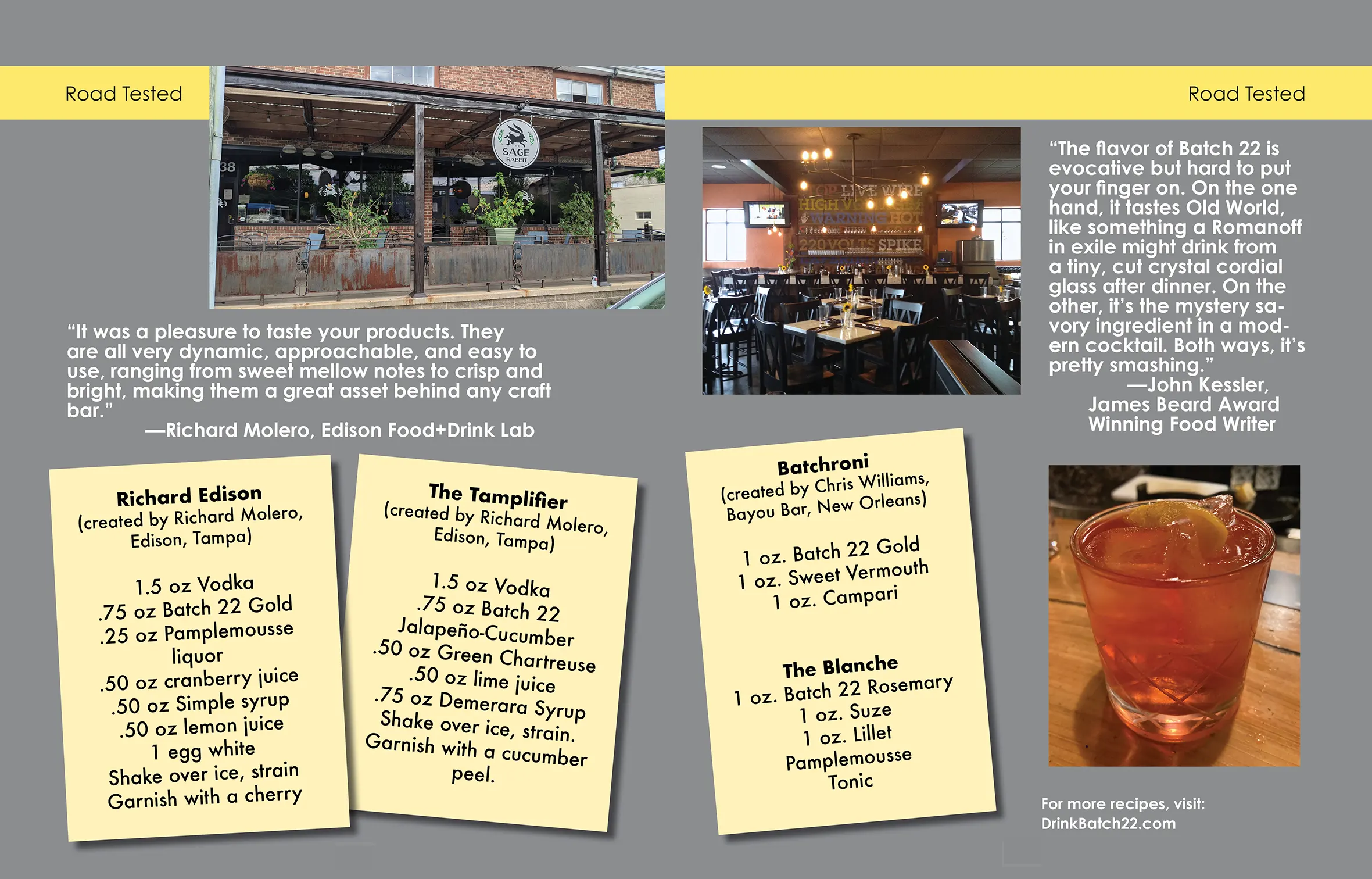
The Stockholm Lemondrop Martini

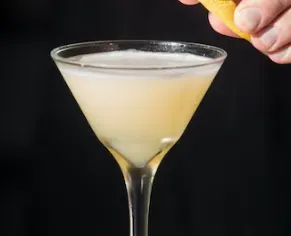
This special martini was created especially for us and debuted at our San Diego launch party in June of 2022. The talented bartenders at Starlite found just the right balance of aquavit flavor and lemon with this delicious and addictive cocktail.

Instructions

  • In a shaker with ice combine:
    • 2 oz. Batch 22 Classic Gold aquavit
    • .75 oz. fresh-squeezed lemon juice
    • .75 oz. simple syrup
    • .5 oz. aquafaba
  • Shake and strain into a martini glass. Garnish with a lemon peel twist.

Serves 1
(Created by Starlite, San Diego)

Wedding Vow

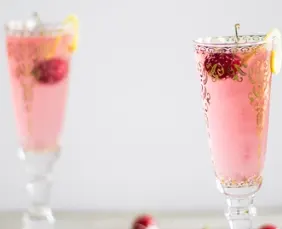
During a recent R&D session, we fell in love with the beautiful aromas and flavors of Rose Cordial syrup, and we were surprised by how great it was when mixed with the aromas and taste of aquavit. Batch and roses? Add some sparkle and you’ve got a wedding (or anniversary!).

Instructions

  • Shake over ice:
    • 2 ozs. Batch 22 Classic Gold aquavit
    • 1 oz. cherry juice
    • 2 tbsp. Rose Cordial syrup
  • Pour into champagne flute
  • Top with Prosecco

Serves 1

Welcome Batch Codder

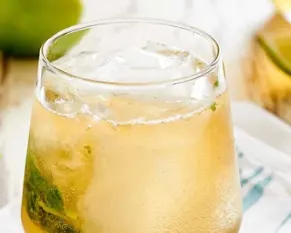
Two of us have East Coast roots, and on the East Coast, the Cape Codder is a ubiquitous summer sipper that always tasted especially delicious after a day at the beach. We improved upon that classic drink recipe by using Batch 22 aquavit instead of the traditional vodka.

Instructions

  • Shake over ice:
    • 2 oz. Batch 22 Classic Gold aquavit
    • 2 oz. cranberry juice
    • Splash Rose’s lime

Serves 1

Batch 22 Made This Impressive Forbes List

Well, it’s party time.

Downtime Cocktails would like to formally invite our fellow honorees—Beyoncé, Bob Dylan, Jason Momoa, and Mike Love—to join us for a celebratory dinner in Los Angeles so we can all toast our being designated one of the “5 Celebrity Spirits That Are Actually Great” by Forbes magazine.

That’s right, Batch 22 is one of only five spirits that Forbes contributor, Erik Ofgang, included on his list of “Great Celebrity Spirits.”

What’s even better is that Ofgang not only considered celebrity spirits, but also weighed his final choices against non-celebrity spirits to make sure they stacked up to his quality standards. He writes, “The…5 spirits were my favorites after trying dozens of spirits from actors, musicians and TV personalities. They were also all in the top tier of my rankings when compared to non-celebrity spirits in their respective categories.”

Now, we don’t generally tout Batch 22 as a “celebrity” spirit, though we do have deep and longstanding roots in Hollywood. Because lots of brands with stars attached get a bad rap for being mediocre (many deservedly so), we prefer to let the complex and delicious liquid in our bottles do the talking for us. Oh, and we’re happy to let Erik Ofgang weigh in as well.

Read the complete article in Forbes

Batching for Good

The season of thanks and giving is now upon us, and so is the season of giving back.

At Downtime Cocktails, we place a lot of value on “doing good” with Batch 22. As a spirit producer, there’s lots of demand for us to attend fundraisers and charity events, and we’re happy to do it as much as we can.  

In the past few weeks, we’ve been especially busy with charity events, so we wanted to highlight the organizations we’ve been helping. They all do wonderful work and are worthy of everyone’s support.

Our fundraising calendar began in earnest back in the first week of August, when we poured to raise money for the Living Coast Discovery Center “Farm to Bay” event in Chula Vista. These folks work to rescue wildlife in need and they provide a wonderful learning environment for families. More information here.

In September, we poured for thousands of attendees at the “Food, Wine, and Brew” celebration that raises money every year for the San Diego Zoo, which not only cares for hundreds of animals downtown, but also conducts critical research and care for a huge variety of species, many threatened or endangered. Check here for more information about the zoo and its many programs.

At the end of the month, we spent two days in La Jolla helping to raise money for the local school district by pouring at the La Jolla Art & Wine festival.  It was a total of more than 12 hours at the booth, but turnout was great and the festival was a huge success. Find information about next year’s event here.

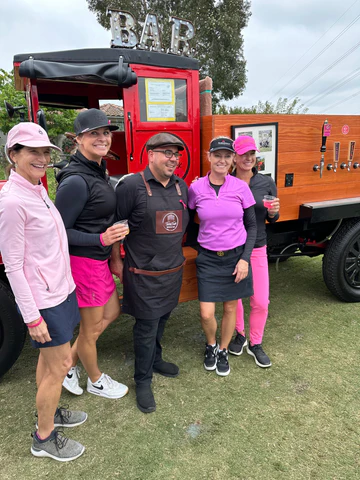
On October 16, we joined our good friends from Fierce&Kind to support the first annual “Angels in Flight” golf tournament at the Rancho Santa Fe Golf Club. Along with our buddies from Tipsy Truck, we poured cocktails to raise money for breast cancer research through the Susan G. Komen Foundation.

On Saturday, October 26, we took the Batch 22 pop-up to the Bobby Riggs Pickleball Center in Encinitas where we provided cocktails to participants who were raising money for Angels Foster Family Network, which is dedicated to providing safe, stable, and loving homes for San Diego infants and toddlers. Look for more information about the great work they do here.

Still to come on November 4: Batch 22 will be slinging cocktails for golfers in Newport who will tee off for the Newport Harbor Athletic Fund, which raises money for athletic programs and injury rehabilitation at the local high school.

Of course, Downtime Cocktails will continue to maintain its strong support for our official nonprofit organization, Charity:Water, which has been providing clean drinking water to developing nations around the world for nearly 20 years. You can get more info and donate to our campaign here.

Mind-blowingly Cool Cocktail Bars

A delicious cocktail is one thing, but it’s made so much better by a great space in which to enjoy it.  That’s not to say your favorite wood-paneled neighborhood watering hole—dimly lighted with neon beer brands buzzing in the windows—doesn’t have its place. Comfort and familiarity are important attributes when they’re needed, but sometimes you want a setting so unique and exhilarating that the cocktails take a back seat to the surroundings. Here are three of those places. If you have a bucket list, we suggest you add at least one of them.

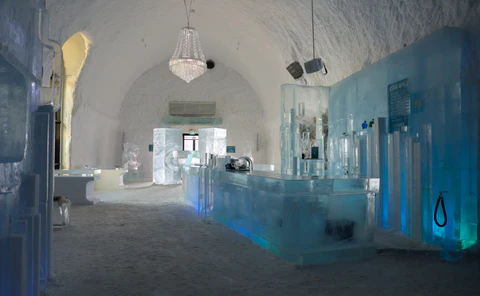
Icebar, Icehotel, Jukkasjärvi, Sweden

Here’s a destination you can literally call the coolest cocktail bar in the world. It’s located in Sweden’s famous Icehotel, in the northern town of Jukkasjärvi and was first opened in 1990. The entire hotel is made from ice and snow, and it’s the largest in the world, measuring more than 64,000 square feet. It uses nearly 1,000 tons of ice in its construction, must be rebuilt every year, and only exists between the months of December and April.

The Icebar is one of the signature features of the Icehotel, which also includes a church, a reception area, a main hall, and 55 guest suites—all formed from snow and huge blocks of ice harvested from a nearby river.

At the bar, guests are served cocktails in glasses made from ice— the chairs, tables, and the bar itself are also ice. Because of the unique nature of their serving vessels, cocktails served at the Icebar are all served “in the rocks.”

Subsix, Maldives

Niyama Maldives is one of the world’s most luxurious resorts. It offers guests private villas and pavilions situated on a group of the company’s private islands and is home to one of the world’s most unique bars. [The Maldives are a group of islands in the Indian Ocean about 400 miles south of the Indian mainland.]

Subsix is the underwater bar and restaurant featured at Niyama resort. Guests are brought to Subsix by speedboat and, upon arriving, they descend a dramatic three-tier staircase to an elaborate oasis below the waves. The unique space is lighted by Italian abstract chandeliers and features the swooping curves of a clam-inspired bar. Soft “anemone chairs” welcome patrons beneath an intricate ceiling draped with thousands of capiz shells.
 
Subsix offers Champagne breakfasts, subaquatic lunches (about $320 per person), gourmet dinners, and adults-only glow parties. A range of signature cocktails is available for $25, including the 75 Islands Martini, which is gin, seaweed vermouth, and galangal (a ginger-like root) & kumquat brine.

Rock Bar, Roack, Bali

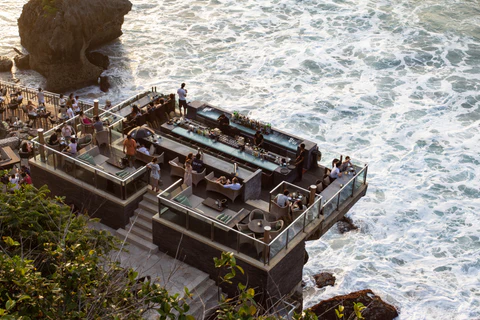
Rock Bar Bali is one of the most stunning features at AYANA Resort and Spa in Bali and certainly one of the world’s most thrilling locations in which to sip a cocktail. Perched on a secluded limestone cliff south of Jimbaran Bay, the bar juts out over the pounding surf, almost 50 feet above the ocean.

Designed by renowned Japanese architect Yasuhiro Koichi, the Rock Bar features a minimalist design with an open-top platform that’s seamlessly built onto the natural cliff formation. Guests can get to the bar one of two ways: They can navigate a long flight of stairs along the cliff, or they can take a finicular, which delivers them to the bar’s landing. Ambient lighting and boat lanterns in traditional fishing boats below enable Rock Bar to offer a uniquely dramatic view of Bali’s famous sunsets.

Among the cocktail favorites are the Rock Bar’s martinis, many of which are blends such as Punch Rock, Rockberry Martini, and Spa on the Rock, which is made of vodka, blackcurrant liqueur, blueberry juice, and cranberry juice.

Who Was P.A. Smirnov?

Before an American vodka producer from Austin, Texas (Tito’s) became the most popular brand of vodka in the world, Smirnoff held that title without challengers. And it had reigned for many decades previous.

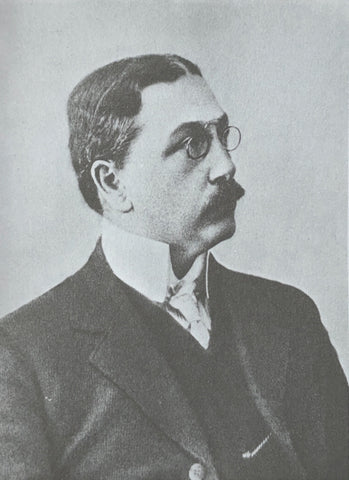
Smirnoff vodka was first produced in Moscow, Russia, by Pyotr Arsenievich Smirnov (1831–1898). Today it’s distributed in 130 countries, and manufactured in many of those locations. In the United States, Smirnoff is produced in Illinois.

Pyotr’s product was first created in 1864, under the brand name PA Smirnov. It was distilled with a unique charcoal filtration technique that Smirnov pioneered in the 1870s. By 1886—after being the first to use newspaper advertising—it became the bestselling vodka brand in Moscow. It also was reputed to be the favorite of Russian royalty.

When PA Smirnov died in 1898, his son Vladimir took over the family business and succeeded in expanding their burgeoning vodka empire. By the turn of the century, Smirnov was producing more than 4 million cases per year.

Despite their great initial success, the early 1900s were not kind to the Smirnovs. In 1904, the Tsar nationalized the production and sale of vodka and Vladimir was forced to sell his distillery and abandon his brand. By 1917, as the Russian Revolution broke out, Smirnov and his family were forced to flee the country. By 1920, Vladimir managed to set up a new factory in Istanbul, Turkey, and then, four years later, moved to Ukraine where he renamed the brand “Smirnoff.” For the next decade, the vodka sold fairly well, but never attained the level of success it had in Moscow before the revolution.

In the 1930s, Vladimir met Rudolph Kunett, a successful Russian businessman whose family had actually supplied the Smirnovs grain in Moscow years before. Vladimir eventually sold the North American rights to his brand to Kunett, who then established the first distillery in North America, located in Bethel, Connecticut.

Sales after Prohibition could never quite keep up with the demands of the company, and, by 1939, Kunett sold his rights to John Martin, the president of Heublein, a successful liquor importer/exporter. Heublein’s board of directors thought Martin was insane for buying the rights to produce vodka. Americans at the time mostly drank whiskey and were unfamiliar with what this foreign spirit was. In a stroke of genius, Martin directed his company to market their vodka as a “white whiskey” that had the benefits of having “no taste, no smell.” Sales exploded virtually overnight.

Heublein was acquired in 1982 by RJ Reynolds Tobacco Company for $1.4 billion. RJR then became RJR Nabisco, which sold the liquor division to Grand Metropolitan in 1987. Ten years later, Grand Metropolitan merged with Guinness to form the global giant that is Diageo.

Ever since PA Smirnov opened his distillery in Moscow, vodka has been one of the most-consumed spirits on the planet. Today, the vodka segment of the alcohol market remains a multi-billion-dollar industry and—despite battling with giants like Tito’s and Absolut—Smirnoff remains one of the most popular and most recognizable brands in the world.

Gold Never Gets Old

Since the launch of Batch 22 two years ago, we’ve been very fortunate to garner great reviews in the press and to win numerous awards. We gotta say, the praise and validation never gets old.

Most recently, Batch 22 won a gold medal at the 2024 New York World Spirits Awards. The competition defines gold-level spirits as, “Exceptional spirits that are near the pinnacle of achievement; these products set the standard for these categories.”

Not to brag, but this makes 10 total medals in the Downtime Cocktails trophy case. In fact, Batch 22 has medaled in every competition it has entered. [Ok, well, that’s a little brag, perhaps.]

The World Spirits competitions are hosted by the Tasting Alliance and are some of the largest and most prestigious in the spirits industry. They employ more than 80 judges from around the world, including Anthony Dias Blue, Jeffrey Morgenthaler, and Wilfred Wong, some of the industry’s most renowned critics.

The New York competition joined forces with the San Francisco World Spirits Competition, which was founded in 2000 and is the oldest and largest competition of its kind. In 2022, the event cemented its position as the largest spirits competition in the world with nearly 5,000 entries.

Crazy Cocktail Contraptions

If you have followed the major trends in the world of food over the past two decades, you know that cutting-edge chefs have employed all sorts of new scientific methods in the preparation of their dishes. They’ve used what has come to be called “molecular gastronomy” to create intriguing new ways to deliver flavors to patrons. This area of culinary exploration often involves the physical manipulation and chemical transformation of foods in ways that create exciting and visually stunning new modes of presentation. Techniques such as spherification, which creates small orbs of caviar-like liquid that burst in the mouth, and aeration, which transforms typically sold ingredients into ethereal foams, mousses, or soufflés, are just two of the most widely used examples of molecular gastronomy.

Cool trends from the culinary world often spill over into the world of cocktails and mixology. Just as chefs have evolved exciting new modes of presentation, so have high-end bars and mixologists. Some techniques are relatively straighforward—a gizmo called the Jet Chill Dry Ice Twin Probe uses food-grade dry ice to infuse cocktails with a wafting cloudlike aura. Flavor Blaster aroma guns create aroma-filled bubbles that can garnish cocktails with an infinite variety of flavors—everything from bubble gum to bourbon, coffee, meat, and herbal and citrus components.

For the more ambitious cocktail innovators—the ones with deeper pockets—there are other more complicated contraptions that are being employed. Here’s a quick overview of four of them.

Rotary Evaporator

Bartenders use this piece of scientific equipment, also called a Rotovap, to create and distill concentrates for cocktails. It works by gently extracting volatile flavors from ingredients at low temperatures (instead of using heat, which oxidizes and sacrifices a lot of flavor integrity) and results in a more concentrated flavor that can be added in measured doses to drinks. The Rotovap can also be used to remove undesirable characteristics from ingredients, such as unpleasant colors or unwanted esters. The machine is also excellent at capturing and preserving the delicate and fresh aroma of spices and herbs that would otherwise be lost if you dried them out or applied heat to them. With a Rotovap, the final product is clean and fresh and unaffected by the flavor-killing effects of too much heat, which is particularly beneficial when working with ingredients such as fruits and herbs.

Some bars use a Rotovap to capture essences and flavors that are not at all commercially available. Alex Kratena at Tāyer + Elementary in London, for example, uses a Rotovap to flavor alcohol with notes of sandalwood. According to Kratena, his Sandalwood Martini contains a distillate that adds a “distinctive, soft, warm, precious wood scent to this amazing classic.”

More and more high-end bars are incorporating the Rotovap into their beverage program, but not without a significant financial investment. A full Rotovap setup will cost upwards of $11,000.

Centrifuge

A centrifuge uses centrifugal acceleration to separate the denser substances in a solution from the lighter elements. Mixologists will often use a centrifuge to break down ingredients into components that can be used separately in cocktail recipes. One bartender, for example, takes a Middle Eastern black lime and breaks it down into a powder that is rehydrated with clarified lime juice. The juice is then injected into the center of ice cubes so the flavor profile of the drink evolves as the cubes melt.

Centrifuges are also used to clarify all sorts of liquids, to turn liquids like coconut milk into coconut butter, to remove impurities in natural products like honey or maple syrup, or to separate essential oils in an ingredient from the water in that ingredient. 

Ultrasonic Homogenizers

Homogenizers use ultrasonic waves to break down cellular structures, which in turn releases trapped components into a surrounding fluid. This technique is often used with botanicals such as herbs, spices, and wood. By sonicating lavender flowers in vodka, for example, ultrasonic forces break the cell walls of the lavender flower and the aromatic molecules and essential oils inside the cell are released into the vodka. After straining the lavender flowers from the alcohol, the remaining liquid is infused with an intense lavender flavor and aroma.

Bartenders and chefs also use homogenizers to create unique cocktails and drinks by blending, flash aging, and modifying textures to create flavor combinations and enhance mouthfeel in new and exciting ways. 

Dehydrators

Dehydrators work by slowly removing moisture from an ingredient with a warm, dry environment that promotes evaporation. Most dehydrators work with a simple system that employs a heat source, an air circulator, and an exhaust that enables the moisture-laden air to escape.

Dehydrated garnishes have become all the rage in the past few years, but dehydrators have many applications in cocktail mixology. As garnishes, dehydrated fruits, herbs, and flowers add concentrated flavor and a unique visual component to cocktails.  Dehydrated garnishes can also be used in alcoholic slushies, where customers can then eat the chewy pieces at the end. 

Dehydrators are also useful for transforming ingredients that would otherwise not be practical, such as berries for Sangria or Bing cherries for an Old Fashioned. Dehydrated ingredients can also help reduce waste by making every part of the fruit usable. 

Unlike Rotovaps and other high-tech scientific equipment, dehydrators are relatively inexpensive and easy to use in a home kitchen. Some of the top brands sell for $100 to $200 and are readily available through many retail outlets.

America’s Best Bartenders

We love PUNCH and punchdrink.com. It’s one of our favorite sources for information about what’s hot, cool, creative, and exciting in the world of spirits and cocktails.

PUNCH recently announced their list of the Best New Bartenders in America, which they have compiled since 2018. Each of their picks has evolved and perfected a particular style of cocktail in a unique and engaging way. And each bartender showcases the all-important human and social aspects that are critical to doing this job well.

Here’s a list of the talented folks who are being honored for 2024, along with the establishments they represent and the cocktail they are best known for. If you’re fortunate enough to have an opportunity to visit one of these bars, be sure to check out the cocktail program. You’ll be very glad you did.

Kitty Bernardo (Paradise Lost), New York City

Signature cocktail: Attack of the Banantulas (a Filipino-inspired riff on a banana Daiquiri)

Justin Brody (Port of Call) Mystic, Connecticut

Signature cocktail: Last Night by the Jetty (Brody says it’s “the love child of a margarita and an Old Fashioned”)

Allison Everitt (Kiesling) Detroit, Michigan

Signature cocktail: Filthiest Martini (an extra dirty version of the classic made with nori-infused vodka and a house-made brine flavored with olives, roasted garlic powder, dashi, rice vinegar and MSG)

Manny Hernandez (Stokes Adobe) Monterey, California

Signature cocktail: The Hana (a floral, citrusy, creamy gin cocktail that pays homage to classic Japanese flavors)

Antonio Jimenez (Bolo) Philadelphia, Pennsylvania

Signature cocktail: La Croabas (a dirty gin Martini with chile oil–washed dry vermouth and ceviche brine)

Tom Liu (Thunderbolt) Los Angeles, California

Signature cocktail: Fu Gwaa Falsetto (a riff on a swizzle, with bitter melon, shochu, rum, gentian, lemon, and salted plum powder)

Jackson Mercier (Bryant’s Cocktail Lounge) Milwaukee, Wisconsin

Signature cocktail: Stop-And-Go Light (a rum and brandy elixir with Créme de noyaux, lime juice, vanilla, and peach bitters)

Thi Nguyen (Moon Rabbit) Washington, D.C.

Signature cocktail: Hết Nước Chấm | Out of Dipping Sauce (a vodka cocktail with lemon, and passionfruit that evokes the flavors of classic Vietnamese dipping sauce)

Jordan Valls (Palomar) Portland, Oregon

Signature cocktail: Rusty Nail (a riff on the classic Scotch cocktail that uses papaya cordial and cocoa bitters to add a tropical twist)

Shaun Williams (Jewel of the South) New Orleans, Louisiana

Signature cocktail: Deiji (a Japanese-inspired margarita-style cocktail with Roku gin, sake, and house-made yuzu Curaçao)

No matter where you get your cocktails—in your neighborhood or while traveling—it’s always nice to support exceptional bartender creativity wherever you see it. So, the next time you see a drink that includes something like house-made yuzu Curaçao or chile oil-washed vermouth, give it try! Encourage the extraordinary!

Verify your age (21+) by entering your birth year.